
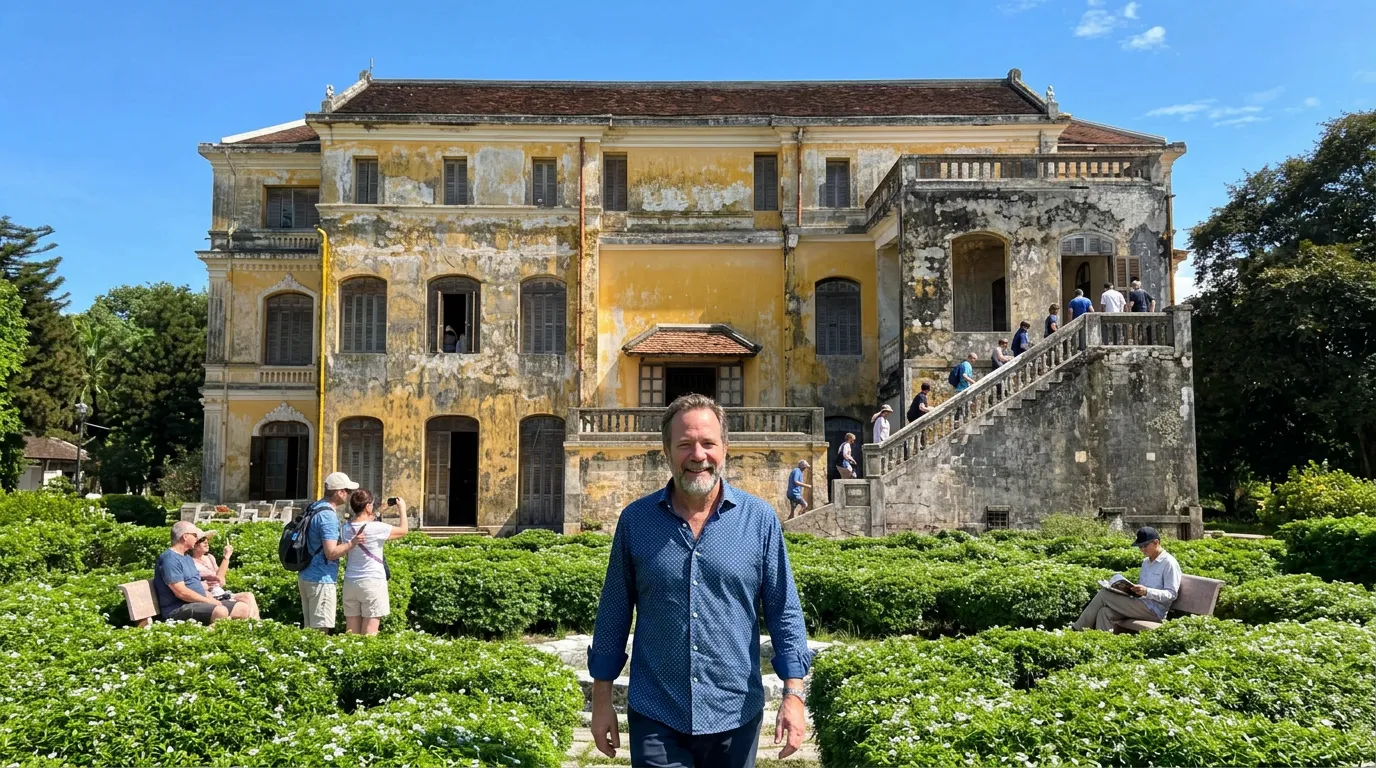
The Imperial Citadel gets all the glory. It dominates the tourism conversation in Hue – and for good reason, it’s massive – but because of that, An Dinh Palace often slips under the radar. It is a UNESCO site, yet it sees a fraction of the foot traffic. To get a different angle on how the royals actually lived their daily lives, I spent some time wandering through this palace on my last trip to Hue. The structure you see today was finished in 1917, though construction started in the early 1900s. It was built to be the private residence for Emperor Khai Dinh and his son, the boy who would grow up to be Emperor Bao Dai.
Here is the thing that makes this spot so fascinating to me: it wasn’t just a ceremonial hall. It was a home. It remained the actual residence of the royal family even after the dynasty collapsed. Following his ascension to the throne, Bao Dai kept living here. And after he abdicated in 1945? His wife, Empress Nam Phuong, stayed here with their children. Unlike the Citadel, which can feel like a vast, empty museum, walking these halls feels intimate. You get a real sense of the “last days of the monarchy.”

The An Dinh Palace in Hue, Vietnam
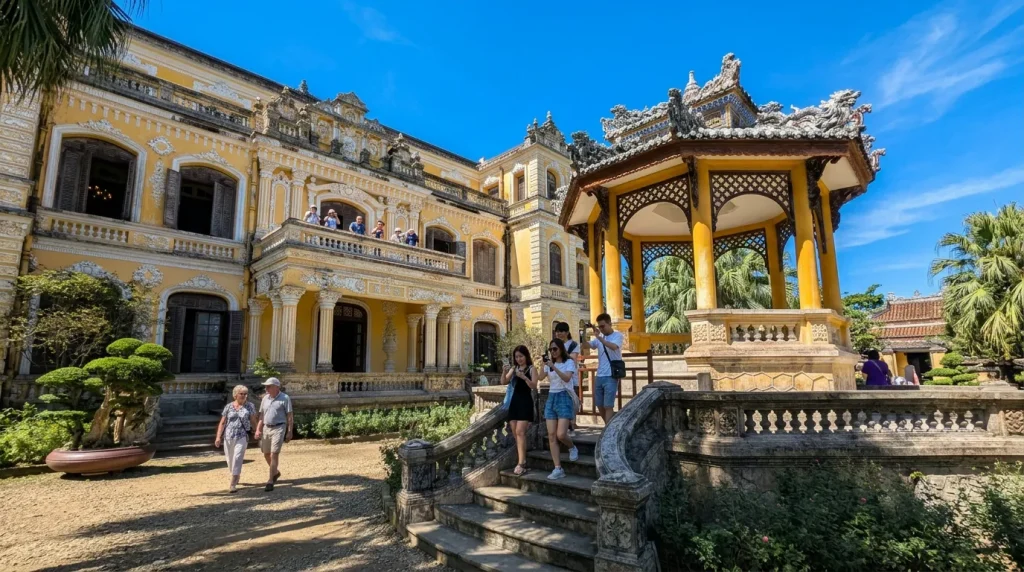
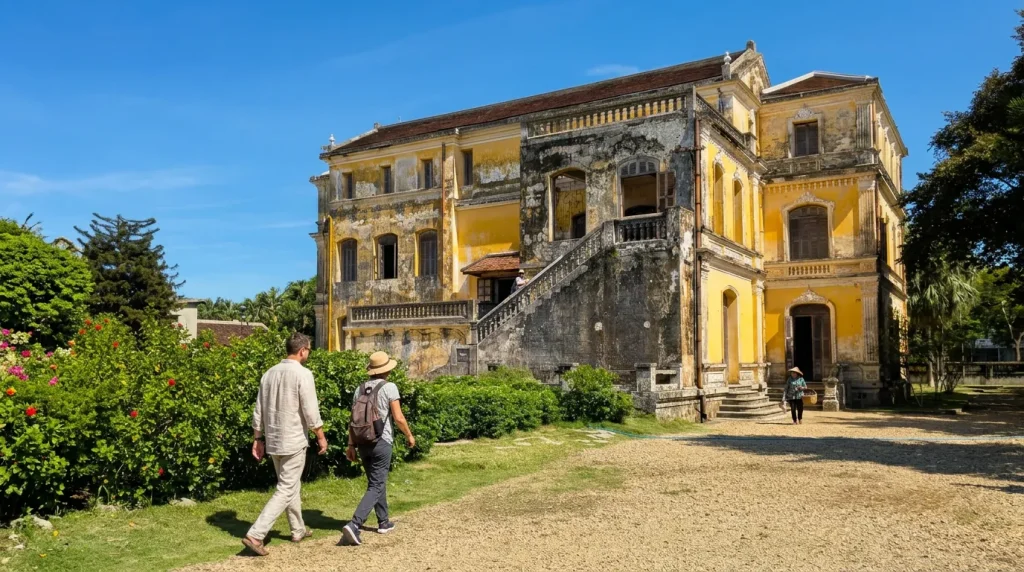
An Dinh Palace is probably the best example you will find of the “Indochine” style. It is this distinct, somewhat clashy blend of traditional Vietnamese motifs and European neoclassicism. The Imperial City is purely traditional; this is something else entirely. You honestly won’t find this specific visual aesthetic anywhere else in Vietnam. You have these intricate Asian relief patterns sitting right next to ornate, Roman-style columns. The whole facade is this vivid, unapologetic yellow.
Crucial tip: You need to bring cash. Do not forget this. The ticket booths at government-run UNESCO sites in Hue pretty much never have credit card machines. It’s old school. To avoid a frantic scramble at the gate or having to run back to town, make sure you withdraw Vietnamese Dong (VND) from one of the ATMs along the main streets of Hue before you even head over.
If you are plotting out a trip to Hue, you should definitely take a look at my guides for the Thien Mu Pagoda, the massive Imperial City, and the royal tombs of Emperors Minh Mang, Tu Duc, and Khai Dinh. There is a lot to see. You can discover more activities here.
An Dinh Palace Visitor Info
| Location | Google Maps (It’s at 97 Phan Dinh Phung Street, right along the An Cuu River) |
| Hours | Winter: 7 AM to 5 PM / Summer: 6:30 AM to 5:30 PM |
| Cost (cash only) | Adults: 50.000 VND (roughly $2 USD) / Children under 12: Free |
| Hue sites tour | Hue Private City Tour (Customizable) |
| How much time | You should allocate roughly 30 to 45 minutes for a visit |
| When to visit | *Best in February, March, or April (try to visit late afternoon or early morning to escape the heat) |
| Accessibility | There are no elevators or wheelchair ramps; visitors can access two floors via stairs |
Because An Dinh Palace is one of the rare attractions situated right inside the main section of Hue, it is super convenient to stop here at the end of the day or just knock it out first before heading elsewhere.
My Visit to An Dinh Palace in Hue
Heading inside the palace
Getting here: The palace sits right on the banks of the An Cuu River, positioned on the edge of Hue’s main district. The vibe is different here. It’s leafy, residential. It feels less like a tourist trap and more like a neighborhood. I was staying about 2 km away at the Scarlett Boutique Hotel inside the city and zipped over on my scooter. That is my preferred method for seeing Vietnam – two wheels are just better. The drive down Phan Dinh Phung Street is lovely, actually. The whole road is shaded by these ancient trees that date back to the colonial era.
If you happen to be staying at the Indochine Palace, you are practically neighbors. It is less than 1 km away. I stayed there earlier in my trip, so I know the area well.
The central area of Hue is surprisingly walkable, so you could just walk to the palace if your hotel is close enough. The sidewalks in this district are generally in better condition than the broken pavement you find in the busy commercial zones. Or, just use the Grab app. It is the easiest way to visit Hue’s attractions or get here without haggling. It’s an all-in-one app for food delivery and taxis. You can select a GrabBike (scooter taxi)—which is faster and cheaper during rush hour – or a GrabCar if you want the A/C. You can see my other recommended apps for Vietnam travel here.
The front gate and ticket booth — scooter parking inside to the right
When you pull up, the first thing that hits you is the magnificent main gate. It’s called the Tam Quan Gate. It is a two-story structure absolutely covered in sanh su—that famous porcelain mosaic art specific to Hue. If you stop and look closely at the pillars, you will see phoenixes and dragons that look like they are crawling right out of the plaster.

The grounds are impeccable. Beautifully maintained. There was a gardener carefully trimming the hedges along the walkways while I was there. To the right, in the palace’s backyard, you will find the bathrooms housed in a separate building. Even the restrooms match the yellow architectural style of the main structure. While the third floor (which was historically used for storage and worship) is closed off, the palace has two floors fully open to visitors.
Like a lot of historic sites in Hue, the palace is a magnet for locals taking pictures. It’s become a bit of a trendy Instagram location recently, especially after gaining fame as a filming location for Vietnamese movies like Camellia Sisters. I saw several groups doing full-on photoshoots: students looking for a vintage backdrop, wedding photography, and women dressed in Ao Dais (the traditional Vietnamese split tunic).
I spotted two bronze statues on the grounds. The big one out front is Emperor Khai Dinh. It sits inside the Trung Lap Pavilion, which is this octagonal gazebo dead center in the courtyard. The statue really captures the Emperor’s known love for elaborate dress – he’s depicted in full military regalia.
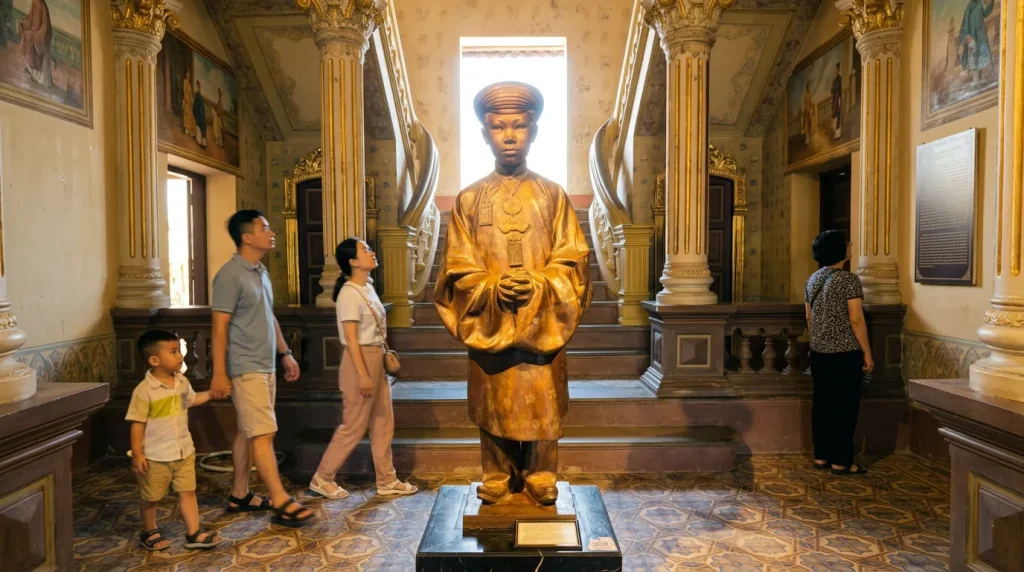
Inside the palace, there is a smaller statue. This one is of Emperor Bao Dai as a boy. It was created by Paul Ducuing, a French sculptor who was also the guy who crafted the statue of Khai Dinh on his throne (the one currently sitting in Khai Dinh’s tomb). Ducuing was a big deal back then, a prominent artist commissioned by the Nguyen court to create these effigies. It really symbolizes how heavy the French cultural influence was on the monarchy during that specific era.
Outside the palace, with a large statue of Emperor Khai Dinh
Inside the palace — a Vietnamese woman was having her wedding photography taken
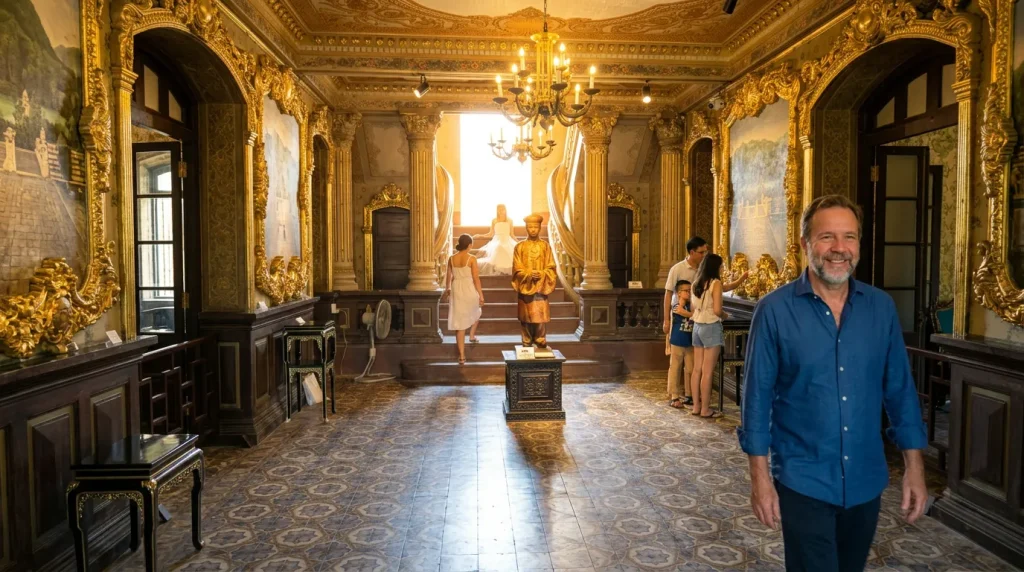
The main building is called Khai Tuong Lau (Pavilion of Auspicious Beginning). When you step into the main hall, the interior design stops you in your tracks. It feels like a European manor. You expect the dark wood of traditional pagodas, but instead, you get this airy space where the walls are covered in Asian symbols and floral motifs.
Painting of Emperor Minh Mang’s tomb and a bronze statue of Emperor Bao Dai
Visitors are free to wander the two available floors. There were plenty of locals taking photos all over the palace when I was there. Scattered around both floors, you will find various smaller sculptures, murals, and artwork.
The central hall on the ground floor houses the most impressive stuff. Here, you will see large wall murals depicting the six royal tombs of the Nguyen Dynasty emperors. These aren’t just hung paintings; they are painted directly onto the walls within ornate moldings. It’s a rare opportunity to see the tombs as they looked in the early 20th century, before time and war took their toll. The photo I captured above shows the specific painting of Emperor Minh Mang’s tomb layout.
It was nice to check out the palace backyard, partly because the skies were blue during my visit, which always helps. As I mentioned, the bathrooms are in that building on the right side of the picture below.

Looking at the palace’s backyard
In the backyard of the palace
Recently, the garden area behind the palace underwent some restoration. Historically, this was the Bach Tra Vien (White Camellia Garden). It was a serene space where the royal family could just relax and be a family. Although the original theater on the grounds was destroyed during the war, the garden remains a peaceful escape from the noise of the city streets.
The back of the palace
Bottom line: This is a great bonus activity in Hue. It is easy to set aside 30 to 45 minutes to visit since it is so near the main area of the city. The architectural contrast between the ancient Citadel and this “modern” palace gives you a complete picture of Vietnam’s royal history. I would include it if you are in Hue for a few days and want to see everything. But, honestly, if your schedule is tight, I would prioritize the palace lower on your list – maybe tackle it after visiting the Tomb of Khai Dinh and the Imperial City.